
EMI Loan Calculator: Calculate Your Monthly Loan Payment In 2026
Taking a loan can make a big purchase possible when you do not have the full amount available today. It could be a home, car, education, business expense or an unexpected personal need. But before accepting a loan offer, one question usually comes to mind: How much will I have to pay every month?
An EMI Loan Calculator can give you a quick answer. You enter the loan amount, interest rate and repayment period, and the calculator estimates your monthly EMI along with other useful figures. This makes it easier to understand the real cost of borrowing before you commit to a loan.
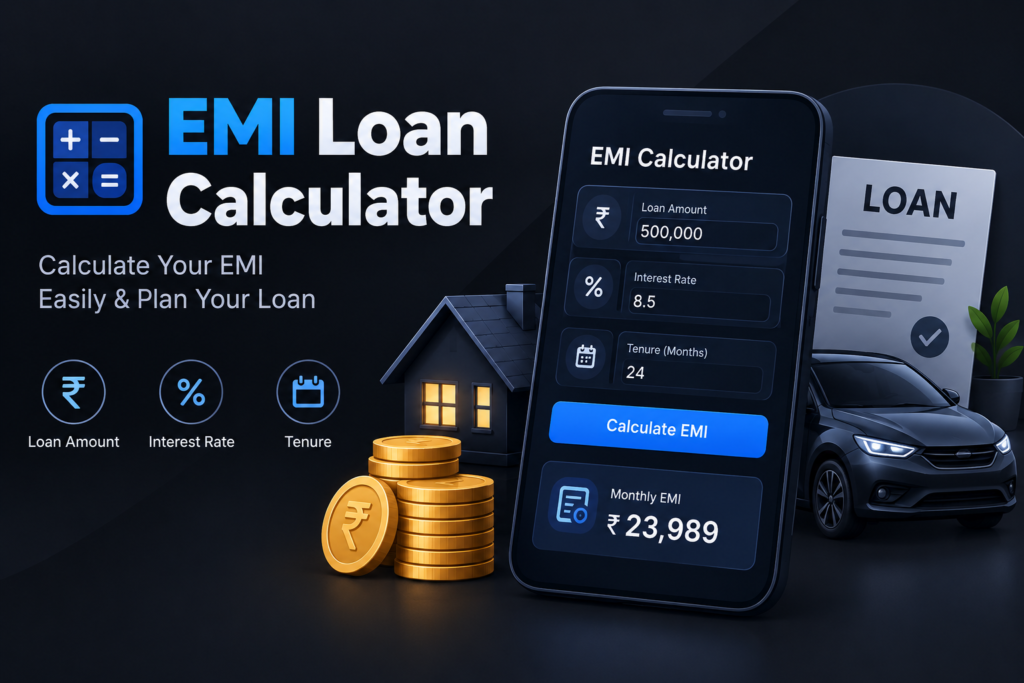
What Is an EMI Loan Calculator?
An EMI Loan Calculator is an online financial tool that helps you estimate the monthly instalment of a loan. EMI stands for Equated Monthly Instalment, which is the amount a borrower generally pays toward the loan each month.
The calculation mainly depends on three things: the amount you borrow, the interest rate and the loan tenure. These are also the basic inputs used by major EMI calculators such as Groww and SEBI Investor.
The result can help you understand whether a particular loan fits comfortably into your monthly budget. Instead of doing the calculation manually, you can change the numbers and compare different loan scenarios in seconds.
Why Use an EMI Loan Calculator?
The biggest advantage is that it lets you see the monthly commitment before taking the loan. A loan may look affordable when you only look at the amount you want to borrow, but the interest and repayment period can make a big difference to what you eventually pay.
For example, imagine you want to borrow money for a car. You might be comfortable with the purchase price, but the monthly EMI could put pressure on your regular expenses. Checking the EMI first gives you a chance to adjust the loan amount or repayment period before making the final decision.
An EMI calculator is also useful when comparing lenders. If two lenders offer different interest rates or repayment periods, you can enter both sets of numbers and see how the monthly payment and total interest can change.
What Information Do You Need?
Most EMI calculators require three basic inputs:
- Loan Amount: The amount you plan to borrow.
- Interest Rate: The annual interest rate charged on the loan.
- Loan Tenure: The period over which you plan to repay the loan.
Some advanced calculators provide additional information such as total interest, total amount payable, monthly interest, outstanding balance and an amortization schedule. SBI’s home loan calculator, for example, shows EMI, total interest payable and total payments over the loan term.
How Does an EMI Loan Calculator Work?
The calculator uses a mathematical formula to estimate your monthly payment. The standard reducing-balance EMI formula is:
EMI = P × R × (1 + R)ⁿ ÷ [(1 + R)ⁿ − 1]
Here, P represents the principal loan amount, R represents the monthly interest rate and N represents the total number of monthly instalments.
You do not need to calculate this formula yourself. The whole purpose of an online EMI Loan Calculator is to do the calculation instantly so you can focus on comparing your options and planning your budget.
EMI Example
Let’s take a simple example. Suppose you borrow ₹5,00,000 at an annual interest rate of 10% for 5 years. The calculator converts the annual rate into a monthly rate and uses the 60-month repayment period to estimate the EMI.
For these numbers, the monthly EMI is approximately ₹10,625. Over the full five years, you would pay about ₹6,37,500 in total, meaning roughly ₹1,37,500 would be the interest component.
The exact result can vary depending on the calculation method, lender terms and any additional charges. This is why an EMI calculator should be used as a planning tool rather than treating its result as a final loan offer.
EMI Depends on More Than the Loan Amount
It is easy to think that borrowing less is the only way to reduce your EMI. While the loan amount is important, the interest rate and repayment period also have a major effect. Just like choosing the right settings when using an AI Hairstyle Generator, it is important to consider all the factors that affect the final result.
A longer tenure can reduce your monthly EMI because the repayment is spread over more months. However, you may pay more interest over the full loan period. A shorter tenure can increase your monthly payment but may reduce the overall interest cost.
This is one of the most important things to understand before choosing a loan. The lowest monthly EMI is not automatically the cheapest option..
Loan Tenure and EMI
Loan tenure is the amount of time you have to repay the loan. It can be expressed in months or years depending on the calculator and lender.
Suppose you take the same loan amount at the same interest rate. Choosing a five-year tenure will normally result in a higher EMI than choosing a ten-year tenure. However, the ten-year option can result in a larger total interest payment because you are borrowing the money for a longer period.
This is why it helps to compare at least two or three tenure options instead of selecting the longest period simply because it gives you a smaller monthly payment.
Interest Rate and EMI
The interest rate directly affects your borrowing cost. Even a small difference in the rate can become significant when the loan is large or the repayment period is long. For example, tools such as JelloChat APK may help users explore different digital features, but when planning a loan, the interest rate remains one of the key factors to consider.
For example, a home loan may run for many years. A small change in the interest rate can therefore affect both your monthly EMI and the total amount paid over the entire loan period.
An EMI Loan Calculator makes this easier to understand because you can change the interest rate and immediately see how the estimated payment changes.
Principal and Interest: What Is the Difference?
When you make an EMI payment, the money generally goes toward two parts of the loan: principal and interest.
The principal is the actual amount you borrowed. Interest is the cost charged by the lender for providing the money. As the outstanding principal reduces, the interest portion of future payments can also reduce under a standard reducing-balance structure.
This is why looking only at the EMI does not tell you the complete story. You should also check the total interest and total repayment amount.
What Is an Amortization Schedule?
An amortization schedule shows how your loan changes over time. It can show how much of each payment goes toward principal and interest and how much of the balance remains.
This is especially useful for long-term loans. SBI’s home loan calculator provides detailed calculations including EMI, total interest and total payments, while other calculators can provide yearly or monthly amortization details.
Looking at an amortization schedule can make the loan feel much more real. Instead of seeing only one EMI number, you can understand how the outstanding balance changes throughout the repayment period.
EMI Loan Calculator for Different Types of Loans
Home Loan EMI Calculator
Home loans usually involve a large principal amount and a long repayment period. Because of this, even a small change in the interest rate or tenure can make a noticeable difference to the total repayment.
A home loan EMI calculator can help you compare different loan amounts and repayment periods before you start the application process.
Car Loan EMI Calculator
A car loan calculator can help you understand the monthly cost of financing a vehicle. You can also compare the effect of making a larger down payment and borrowing less.
This can be helpful when choosing between a more expensive car with a large EMI and a less expensive option that leaves more room in your monthly budget.
Personal Loan EMI Calculator
Personal loans are often used for expenses such as home improvements, education, weddings, travel or unexpected financial needs. Since these loans can have different interest rates and repayment periods, calculating the EMI before applying is important.
If the EMI looks too high compared with your regular income and expenses, you may want to reconsider the loan amount or explore other options.
Education Loan EMI Calculator
Education loans can have different repayment structures and may include special repayment conditions. An EMI calculator can still be useful for getting a general idea of future monthly payments.
Before taking an education loan, check the lender’s actual terms, including any moratorium period and when repayment begins.
How to Use an EMI Loan Calculator
Using an EMI Loan Calculator is usually simple.
First, enter the amount you want to borrow. Do not automatically enter the maximum amount a lender may offer. Think about how much you actually need.
Next, enter the expected annual interest rate. If you are comparing lenders, use the rate offered by each lender separately so you can see how the EMI changes.
Finally, enter the repayment tenure in months or years. The calculator will then show the estimated monthly EMI. Depending on the tool, you may also see the total interest and total amount payable.
How to Find an EMI You Can Afford
A calculator tells you what the EMI could be, but only you can decide whether that EMI fits your life. Your monthly income is only one part of the picture. Rent, food, utilities, existing EMIs, savings and unexpected expenses all need to be considered.
For example, an EMI might look manageable when you have no other debt. But if you already have a car loan, credit card balance or another personal loan, adding another large payment can make your monthly budget uncomfortable.
A good EMI is not simply the smallest number on the screen. It is an amount you can continue paying without putting your essential expenses and savings under unnecessary pressure.
How to Reduce Your EMI
There are several ways to reduce the monthly payment, although each option has a trade-off.
You can borrow a smaller amount, choose a longer repayment period or find a loan with a lower interest rate. A larger down payment can also reduce the amount you need to borrow.
However, extending the tenure only to get a lower EMI can increase your total interest cost. Before making the decision, compare both the monthly payment and total repayment.
Should You Choose a Longer Tenure?
A longer tenure can be useful when you need to keep your monthly payment lower. It can make the loan easier to manage during the early years.
The downside is that the loan remains active for longer and you may pay more interest overall. If your income increases later, you may be able to make additional payments or prepay the loan, depending on your lender’s terms.
The right tenure depends on your income, expenses, loan amount and financial goals. There is no single tenure that is best for everyone.
What Happens If Interest Rates Change?
For a fixed-rate loan, the interest rate generally remains fixed according to the loan agreement. For a floating-rate loan, the rate can change according to the applicable benchmark and lender terms.
When the interest rate changes, your EMI or repayment period may change depending on how your lender handles the adjustment. This is one reason why the EMI shown by a calculator should not be treated as a permanent number unless the loan terms support that assumption.
Always check whether the loan uses a fixed or floating rate before making a long-term repayment plan.
EMI Loan Calculator and Prepayment
Prepayment means paying part or all of your outstanding loan before the scheduled end of the tenure. Depending on the loan and lender, making additional payments may reduce the outstanding principal and potentially lower the interest you pay in the future.
But prepayment rules and charges can vary. Before making a large payment, check the lender’s current terms and any applicable charges.
An EMI calculator can also help you compare scenarios. You can calculate your existing repayment and then estimate what happens if you reduce the outstanding amount or shorten the remaining tenure.
Common Mistakes When Using an EMI Calculator
One common mistake is entering the wrong interest rate. Make sure you understand whether the rate you are entering is an annual rate and whether it matches the lender’s actual offer.
Another mistake is focusing only on the EMI. A longer loan can produce a smaller monthly payment while increasing the total interest paid over time.
It is also easy to forget additional costs. Processing fees, insurance, taxes, documentation charges and other lender-specific costs may not be included in a basic EMI calculation.
EMI Calculator vs Manual Calculation
You can calculate EMI manually using the standard formula, but doing it repeatedly can be inconvenient. An online calculator makes it easier to test different loan amounts, interest rates and repayment periods.
For example, you could compare a ₹5 lakh loan for five years with the same loan for seven years. You can then change the interest rate and immediately see how the estimated EMI and total repayment change.
This makes an EMI calculator particularly useful during the comparison stage before you finalize a loan.
Is an EMI Loan Calculator Accurate?
An EMI calculator can provide a mathematical estimate based on the numbers you enter. However, the final amount charged by a lender can depend on the actual loan terms, rate type, fees, repayment structure and other conditions.
SEBI’s EMI calculator itself carries a disclaimer that its calculators are for illustration.
So, use the calculator to plan and compare. Before signing a loan agreement, check the lender’s official offer and repayment schedule for the final figures.
EMI Loan Calculator for Financial Planning
An EMI is not just another bill. It can affect how much money you have available for savings, emergencies, investments and everyday spending.
Before taking a loan, try adding the estimated EMI to your current monthly budget. If the number leaves you with very little room for unexpected expenses, the loan may be too large for your current situation.
Sometimes the better decision is not to ask, “How much loan can I get?” but rather, “How much can I comfortably repay?”
Final Thoughts
An EMI Loan Calculator is a simple tool, but it can make a big difference when you are planning a loan. By entering the loan amount, interest rate and tenure, you can get an estimate of your monthly payment and understand how different choices affect the overall cost.
Do not judge a loan by its EMI alone. Look at the total interest, repayment period, additional charges and how the payment fits into your actual monthly budget. A loan should help you reach a goal without turning every month into a financial struggle.
Frequently Asked Questions

Hi, I’m Vikram Ashwin, a technology writer who enjoys covering useful apps, digital tools, photo editing trends, and the latest tech topics. My goal is to share clear information, useful tips, and straightforward explanations without unnecessary technical language.